
I had one of the most spectacular weekends in my own personal history. Friday night was PHS Palooza, an informal gathering of pretty much everyone who went to Peotone High School and has a Facebook account. I know a lot of people like to bag on Facebook, but if it weren't for Facebook, I would not have found and re-friended a lot of awesome people.
Anyway, an old high school friend's band played there on Friday. Black Cadillac was awesome and Trevor, the bass player, should be credited for getting Throwbacks jam-packed full of crazy people who had a blast listening to great music and just generally cutting loose.
Amongst those people were my old school bestie and her husband. I will call them Pink and Stink Lumpkin. They're the coolest. They both know how much I love Take Nora to Work Day and they both also understand my almost unhealthy obsession with the Cal-Sag and any and all to do with its industrial and recreational purposes. Well, Stink works on the tugs and he offered to give me a personal tour.
What kind of crazy girl would say no to an offer like that?
Not this one.
So, despite our night of tall revelry, Pink came to collect myself and Baby Cakes at Juderonomy's house in the late morning hours. We followed her to the tugs, which, by the way, are located very close to Calumet Fisheries, AKA, the site of Smell My Fingers! The Smelliest Food Porn Ever!
I have loads of pictures and I even have some food porn to write about. I cannot, however, give the story of Three Tugs, Taco Mex and a Toddler the proper attention, as I am just taking a quick break from writing my last feature for my wonderful bosslady, Slippy.
The magazine is going really well. I'm almost all done with my assignments. I have only had to minorly ride my freelance friend who is writing features with me. The work has been fun, interesting, a learning experience in general. When it's published, I shall post a link.
Oh, and the nun's booklet is finally done. It looks beautiful and all of the nuns are very happy with the final product. We won't be working on the second issue for another month or so, so, that's all the news on that front.
Anyway, stay tuned. The tug boat adventure with the Lumpkins was so incredibly fun, informative, adventurous and full of laughs (not to mention topped off with some of the best damn Mexican food I have ever had the pleasure of gorging upon) that I need to devote hours getting the pictures from my BlackBerry to my laptop and confirming the details of the machinery with Stink.
So, please bear with me. I'm working on being a fun blogger again and thanks to the Lumpkins, I am off to a great start!
Showing posts with label Take Nora To Work Day. Show all posts
Showing posts with label Take Nora To Work Day. Show all posts
Monday, April 6, 2009

Tuesday, February 24, 2009
So Exciting
The honchos at The School I'm freelancing at love the ideas for the magazine Slippy and I cooked up over lunch at Windy City Subs a few weeks ago. They totally went with our proposal and the freelance writer I hired is going to do some amazing work, too. He has taken our idea for his feature and elevated it to a super kick ass level. Now I just have to write a few stories, edit a magazine and voila--I will have experienced the creation of a publication from concept to delivery. Awesome!
Tuesday, December 2, 2008
I'm In Love With A Sandwich
It's a rare pleasure for me to be able to give a delectable food-porn item a name.
Reuben.
Slippy and I hit Windy City Subs for lunch today, and I had one thing on my mind. My sweet, succulent Reuben.
Grilled, buttery rye bread. Juicy, pink corned beef. Extra sauerkraut. Thousand Island dressing. All smooshed together into a hot, messy mess, first in my hands and now in my belly.
Oh, sweet Reuben. We must do this more often.
It's a slow day here at "work." It's sort of like Take Nora to Work Day, because I have very little to do in an official capacity, so I'm going to grade some of Slippy's papers for the class she teaches. I love being Slippy's Bitch. It's so fun. She is a kind, benevolent mistress. Ok, off to grade papers like a good TA. (That's teaching assistant. Not Tits and Ass. Or is it?)
Reuben.
Slippy and I hit Windy City Subs for lunch today, and I had one thing on my mind. My sweet, succulent Reuben.
Grilled, buttery rye bread. Juicy, pink corned beef. Extra sauerkraut. Thousand Island dressing. All smooshed together into a hot, messy mess, first in my hands and now in my belly.
Oh, sweet Reuben. We must do this more often.
It's a slow day here at "work." It's sort of like Take Nora to Work Day, because I have very little to do in an official capacity, so I'm going to grade some of Slippy's papers for the class she teaches. I love being Slippy's Bitch. It's so fun. She is a kind, benevolent mistress. Ok, off to grade papers like a good TA. (That's teaching assistant. Not Tits and Ass. Or is it?)
Wednesday, November 19, 2008
Color MeTruant!
Press Checks Rule!
I just got word from Slippy that we might have to take another very important field trip to see Roy G. Biv at Ausmeer Inc., the printing outfit where she once worked and now hires as often as possible for projects at Slippy U. The thinly-veiled field trip we took last week might cause some to suggest I spent company time in ways that could be construed as "wasteful" or "fraudulent" but I found my lunch and field trip with Slippy and Roy to be ever so informative, giving me a rare glimpse into the world of printing presses.
We walked into Ausmeer and made our way back to Roy's office. A nice lady popped her head in and said that the checks had been bumped back an hour and a half.
"Guess it's lunch-time then," Roy said, and suggested we meet at a local bar not far from the place where the checks were going to happen. That confused me.
"I thought the press checks happened here" This kicked off the first in a typically overwhelming amount of questions I asked that afternoon. "Wait--Ausmeer outsourced this job?"
Slippy knew it was coming, and since she likes to indulge me and my millions of questions, she offered me an in-depth response that I had to go back and get in writing, because it's a complicated prospect, both technically and from a business perspective.
"Okay, Ausmeer has a digital press and traditional one and two color presses. And there are companies that have bigger 5 or 6 color presses which is for 4 color process and one or two spot colors or coatings, such as the UV that we used, that outsource only to certain printers."
"So, why don't you just go to that other printer if they have what you need?"
"If I hire Ausmeer and they source the job out, it keeps the cost down for both because the bigger presses are very expensive and most smaller companies can't afford them because of the amount of print you would need to justify owning one. It works out for both companies because it justifies one company buying the press, and it keeps it going non-stop with all of the little shops sending their business to them and the smaller shops don't have to turn down jobs or try to buy a press that they in reality don't have enough business to support."
"So, the whole little press outsourcing to the big ones sounds like those little birds that eat crap out of hippo's teeth. Symbiotic."
"Exactly."
She discussed some press checks that sucked hours, even days from her life. She spent four years in Wisconsin one week, checking the forms around the clock.
"It was a 400 page catalog, running two presses at a time, like three times the size of the one you'll be seeing when we do today's checks. I had to be there constantly, because I had to approve every form. And it sucked because each page was tabbed with a color, so i had to make sure the tabs colors were all consistent between pages. It was brutal. I'd go back to my hotel and try to sleep for like two hours, and then come back. We were running 40,000 catalogs.. a new form every 4 hours for 4 days."
"Man, that sounds an awful lot like work to me. So, what's the worst case scenario if you go to a press check and the form is all fucked up?"
"The worse case scenario is that it doesnt turn out right at all and you have to rerun plates, remix inks, change papers to get the effect that you want. I had that happen with the magazine once and then you have to pick and choose your battles to which is the most important aspect of the print job. It's a give and take game."
We arrived at the pub and ordered some Stellas. Roy hadn't yet arrived and we looked over the menu, knowing that we couldn't get away with a pure liquid lunch. We would have to return to the office eventually.
"What, does it take that long to fix something?"
"Well, some changes can be done on the press like increasing color intensity. Some changes require running new screens which can take hours."
"Time is money."
"That is true," Slippy said. We clinked glasses and drank. "It's frustrating. Sometimes you need to move pages around so certain colors are by each other or so that there isn't heavy coverage on the edges of the paper cuz that pulls it harder and makes the inside pages not print as well."
At this time, Roy ambled up to the table. He looked harried, distressed, like a man who needed a beer at noon. He listened to Slippy learning me good on all things print, and looked at the waitress with relief when she delivered his drink. I would soon learn details that support both my need to hear other people's office dramas and my theory that the adult world is filled with middle-school children playing dress-up.
"I never in a million years thought about this stuff, ever. How many books and magazines and freaking catalogues have I looked at?" I've been reading for most of my life. Here was yet another industry that I relied upon but never considered.
"I'm telling you. There's tons of things to worry about, inks, colors...Oh, purples just love to mess the balance of all colors together. If I use purple, I use it as a spot color usually so it doesnt fuck up the CMYK balance."
"The what?"
"Ever see those little blocks of color on pages?" Roy jumped in. "The blue, pink, yellow and black blocks? They're called printers blocks. Stands for cyan, magenta, yellow and black. It checks the intensity of the color. The intensity of those blends create all the different colors."
"Oh, yeah. Like on TVs and monitors, the little color dots."
"Yeah," he said, "but those are RGB."
I looked up and to the left in thought.
"Red, green and blue," Slippy said.
"I knew that." I totally didn't know the lingo. When he said RGB, I though Roy G. Biv, which became Roy's alias.
Our food came out (food porn flash--I had a really good cobb salad. Juicy chicken and crispy bacon. Yum!) and we discussed some of the office drama at Ausmeer. To know me is to know that I love hearing all of the details about all of my friend's jobs. I never get bored with office gossip, and I got all, "No, he did not!" and "I can't believe it!" with Roy and Slippy. It was perfect, because she used to work there, too, and filled in much back story for me.
Anyway, after my brief primer on how printers worked, I actually got to see one. We walked into a building I'd driven past six thousand times in my life but had never noticed. We walked back into the brightly lit press room. It was filled with machinery and secretive looking men. They all glanced furtively at Slippy, Roy and myself. I beamed, waved and looked at every machine, wanting to poke around and ask them all a million annoying questions to quench my curiosity.
We walked up to a desk that had bright lights shining onto the form, a sheet bearing multiple copies of save the date postcards for Slippy U's big muckety muck ball in the spring. Slippy, Roy and the main guy from the printer stood around the form, discussing color intensity and the UV coating that made the paper so shiny. A loop, much like the ones jewelers use to scope out gems, can be used to make sure the color intensity and blending is to the press checker's satisfaction.
"So, you only used your M and B?" I asked, looking at the shiny burgundy, black and white cards. I felt cool using my new terminology incorrectly.
"No. it was originally set up as a two color job, but we ran it with four color process to ensure the detail stood out," Slippy said. "You can control the gradient better as a four color job."
"Wait, so you used four coats of two colors?" I looked closely at the paper, seeing Seurat-like points of black and wine colors blending into one another.
"It's hard to explain. I'll get you the PMS color swatches next time we go to Ausmeer for you to see how the colors are mixed."
My brief tutorial only illuminated how in-depth the whole process is, and how very mysterious this world remained to me. After Slippy gave the form the old thumbs-up, we retreated to a scuzzy biker bar for one more beer (okay, it was two beers) before going back to work. I then really drilled Roy with questions. I asked so many and without the benefit of total sobriety or a pen and a piece of paper that I shall distill the highlights of what Roy had to say about the printing industry.
It is cut-throat and demand for printers is so high that union print shops are generally too expensive to maintain. Technological advances have made the competition even more insane. His response to my question of whether the internet was sending printers by way of the dodo bird was a sharp laugh.
"No way. There will always be a market for print ads." He went into the cost-effectiveness of distributing a high number of low-cost pieces, bombarding a particular market just to attract a small percentage of people who will eventually buy whatever that ad is selling. According to Roy and Slippy, both well-versed in print media and marketing, print ads are here to stay.
And to bring it all back to why we had to visit two printers to get one press check done, Slippy reminded me, "The industry is so competitive it's in everyone's best interest to pool resources. With technology making it accessible to just about everyone, now it's all about speed and customer service."
Between my rapid-fire question assault and the fires he had to put out back at his office, Roy had to wave the white flag.
"Come on, Roy. Admit it: no one's ever asked you so many questions about what you do for a living."
"You got that right," he answered.
Dear readers, you are not yet off the hook. Tomorrow Slippy and I shall return to Ausmeer. There are many things I did not get to see and many questions I have not yet had answered. Stay tuned for another episode of "Color Me Truant!" a Take Nora to Work Day production presented to you by Shoulda Woulda Coulda.
I just got word from Slippy that we might have to take another very important field trip to see Roy G. Biv at Ausmeer Inc., the printing outfit where she once worked and now hires as often as possible for projects at Slippy U. The thinly-veiled field trip we took last week might cause some to suggest I spent company time in ways that could be construed as "wasteful" or "fraudulent" but I found my lunch and field trip with Slippy and Roy to be ever so informative, giving me a rare glimpse into the world of printing presses.
We walked into Ausmeer and made our way back to Roy's office. A nice lady popped her head in and said that the checks had been bumped back an hour and a half.
"Guess it's lunch-time then," Roy said, and suggested we meet at a local bar not far from the place where the checks were going to happen. That confused me.
"I thought the press checks happened here" This kicked off the first in a typically overwhelming amount of questions I asked that afternoon. "Wait--Ausmeer outsourced this job?"
Slippy knew it was coming, and since she likes to indulge me and my millions of questions, she offered me an in-depth response that I had to go back and get in writing, because it's a complicated prospect, both technically and from a business perspective.
"Okay, Ausmeer has a digital press and traditional one and two color presses. And there are companies that have bigger 5 or 6 color presses which is for 4 color process and one or two spot colors or coatings, such as the UV that we used, that outsource only to certain printers."
"So, why don't you just go to that other printer if they have what you need?"
"If I hire Ausmeer and they source the job out, it keeps the cost down for both because the bigger presses are very expensive and most smaller companies can't afford them because of the amount of print you would need to justify owning one. It works out for both companies because it justifies one company buying the press, and it keeps it going non-stop with all of the little shops sending their business to them and the smaller shops don't have to turn down jobs or try to buy a press that they in reality don't have enough business to support."
"So, the whole little press outsourcing to the big ones sounds like those little birds that eat crap out of hippo's teeth. Symbiotic."
"Exactly."
She discussed some press checks that sucked hours, even days from her life. She spent four years in Wisconsin one week, checking the forms around the clock.
"It was a 400 page catalog, running two presses at a time, like three times the size of the one you'll be seeing when we do today's checks. I had to be there constantly, because I had to approve every form. And it sucked because each page was tabbed with a color, so i had to make sure the tabs colors were all consistent between pages. It was brutal. I'd go back to my hotel and try to sleep for like two hours, and then come back. We were running 40,000 catalogs.. a new form every 4 hours for 4 days."
"Man, that sounds an awful lot like work to me. So, what's the worst case scenario if you go to a press check and the form is all fucked up?"
"The worse case scenario is that it doesnt turn out right at all and you have to rerun plates, remix inks, change papers to get the effect that you want. I had that happen with the magazine once and then you have to pick and choose your battles to which is the most important aspect of the print job. It's a give and take game."
We arrived at the pub and ordered some Stellas. Roy hadn't yet arrived and we looked over the menu, knowing that we couldn't get away with a pure liquid lunch. We would have to return to the office eventually.
"What, does it take that long to fix something?"
"Well, some changes can be done on the press like increasing color intensity. Some changes require running new screens which can take hours."
"Time is money."
"That is true," Slippy said. We clinked glasses and drank. "It's frustrating. Sometimes you need to move pages around so certain colors are by each other or so that there isn't heavy coverage on the edges of the paper cuz that pulls it harder and makes the inside pages not print as well."
At this time, Roy ambled up to the table. He looked harried, distressed, like a man who needed a beer at noon. He listened to Slippy learning me good on all things print, and looked at the waitress with relief when she delivered his drink. I would soon learn details that support both my need to hear other people's office dramas and my theory that the adult world is filled with middle-school children playing dress-up.
"I never in a million years thought about this stuff, ever. How many books and magazines and freaking catalogues have I looked at?" I've been reading for most of my life. Here was yet another industry that I relied upon but never considered.
"I'm telling you. There's tons of things to worry about, inks, colors...Oh, purples just love to mess the balance of all colors together. If I use purple, I use it as a spot color usually so it doesnt fuck up the CMYK balance."
"The what?"
"Ever see those little blocks of color on pages?" Roy jumped in. "The blue, pink, yellow and black blocks? They're called printers blocks. Stands for cyan, magenta, yellow and black. It checks the intensity of the color. The intensity of those blends create all the different colors."
"Oh, yeah. Like on TVs and monitors, the little color dots."
"Yeah," he said, "but those are RGB."
I looked up and to the left in thought.
"Red, green and blue," Slippy said.
"I knew that." I totally didn't know the lingo. When he said RGB, I though Roy G. Biv, which became Roy's alias.
Our food came out (food porn flash--I had a really good cobb salad. Juicy chicken and crispy bacon. Yum!) and we discussed some of the office drama at Ausmeer. To know me is to know that I love hearing all of the details about all of my friend's jobs. I never get bored with office gossip, and I got all, "No, he did not!" and "I can't believe it!" with Roy and Slippy. It was perfect, because she used to work there, too, and filled in much back story for me.
Anyway, after my brief primer on how printers worked, I actually got to see one. We walked into a building I'd driven past six thousand times in my life but had never noticed. We walked back into the brightly lit press room. It was filled with machinery and secretive looking men. They all glanced furtively at Slippy, Roy and myself. I beamed, waved and looked at every machine, wanting to poke around and ask them all a million annoying questions to quench my curiosity.
We walked up to a desk that had bright lights shining onto the form, a sheet bearing multiple copies of save the date postcards for Slippy U's big muckety muck ball in the spring. Slippy, Roy and the main guy from the printer stood around the form, discussing color intensity and the UV coating that made the paper so shiny. A loop, much like the ones jewelers use to scope out gems, can be used to make sure the color intensity and blending is to the press checker's satisfaction.
"So, you only used your M and B?" I asked, looking at the shiny burgundy, black and white cards. I felt cool using my new terminology incorrectly.
"No. it was originally set up as a two color job, but we ran it with four color process to ensure the detail stood out," Slippy said. "You can control the gradient better as a four color job."
"Wait, so you used four coats of two colors?" I looked closely at the paper, seeing Seurat-like points of black and wine colors blending into one another.
"It's hard to explain. I'll get you the PMS color swatches next time we go to Ausmeer for you to see how the colors are mixed."
My brief tutorial only illuminated how in-depth the whole process is, and how very mysterious this world remained to me. After Slippy gave the form the old thumbs-up, we retreated to a scuzzy biker bar for one more beer (okay, it was two beers) before going back to work. I then really drilled Roy with questions. I asked so many and without the benefit of total sobriety or a pen and a piece of paper that I shall distill the highlights of what Roy had to say about the printing industry.
It is cut-throat and demand for printers is so high that union print shops are generally too expensive to maintain. Technological advances have made the competition even more insane. His response to my question of whether the internet was sending printers by way of the dodo bird was a sharp laugh.
"No way. There will always be a market for print ads." He went into the cost-effectiveness of distributing a high number of low-cost pieces, bombarding a particular market just to attract a small percentage of people who will eventually buy whatever that ad is selling. According to Roy and Slippy, both well-versed in print media and marketing, print ads are here to stay.
And to bring it all back to why we had to visit two printers to get one press check done, Slippy reminded me, "The industry is so competitive it's in everyone's best interest to pool resources. With technology making it accessible to just about everyone, now it's all about speed and customer service."
Between my rapid-fire question assault and the fires he had to put out back at his office, Roy had to wave the white flag.
"Come on, Roy. Admit it: no one's ever asked you so many questions about what you do for a living."
"You got that right," he answered.
Dear readers, you are not yet off the hook. Tomorrow Slippy and I shall return to Ausmeer. There are many things I did not get to see and many questions I have not yet had answered. Stay tuned for another episode of "Color Me Truant!" a Take Nora to Work Day production presented to you by Shoulda Woulda Coulda.
Tuesday, November 11, 2008
Press Checks with Slippy and Roy G. Biv
I'm actually working right now, but just to let you all know that even with a job, I still managed to squeeze in a fabulous field trip last week. I got a peek into the wonderful world of printing presses. Slippy's homeboy, Roy, was kind enough to answer my many questions, urging him to observe, "She talks a lot, doesn't she?"
After I get done proofing this here document for Slippy the Bosslady, I will regale you all with the story of how I got to go on "press checks" which is sometimes an arduous process ... and other times just means getting paid to enjoy a field trip, free lunch and a few beers on company time.
Stay tuned!
After I get done proofing this here document for Slippy the Bosslady, I will regale you all with the story of how I got to go on "press checks" which is sometimes an arduous process ... and other times just means getting paid to enjoy a field trip, free lunch and a few beers on company time.
Stay tuned!
Wednesday, October 29, 2008
The Apocalypse Draws Near
I am currently employed on a part-time basis. That surely is a sign that the sky is falling. It's just a little writing and editing over at Slippy University twice a week. When she asked me if I'd be interested in doing some part-time freelance work, I told her I would be. Nepotism rules.
My first day was fun. I got to wield a red pen, thrash at some articles, proof some items and such. I sit in a cute office with a nice view of a busy city street and Slippy is right on the floor below me. Smoke breaks and lunch twice a week with Slippy--how lucky am I? It's like Take Nora To Work Day every Tuesday and Thursday!
So, while I'm playing the role of freelance writer twice a week, my little Baby Cakes is living it up at my pre-school alma mater. His first day was great. When the Mister and I dropped him off on Tuesday, he barely spared us a backward glance. He was off and running. When I picked him up, he kind of looked up at me like, "Oh, you're here, too? Cool. Here, hold this block for me, wouldja?" He totally charmed the staff and got good reports for his first day--of course!
Anyway, I imagine this new chapter in my life might yield interesting stories to share. Or not. Depending on who might be reading ...
My first day was fun. I got to wield a red pen, thrash at some articles, proof some items and such. I sit in a cute office with a nice view of a busy city street and Slippy is right on the floor below me. Smoke breaks and lunch twice a week with Slippy--how lucky am I? It's like Take Nora To Work Day every Tuesday and Thursday!
So, while I'm playing the role of freelance writer twice a week, my little Baby Cakes is living it up at my pre-school alma mater. His first day was great. When the Mister and I dropped him off on Tuesday, he barely spared us a backward glance. He was off and running. When I picked him up, he kind of looked up at me like, "Oh, you're here, too? Cool. Here, hold this block for me, wouldja?" He totally charmed the staff and got good reports for his first day--of course!
Anyway, I imagine this new chapter in my life might yield interesting stories to share. Or not. Depending on who might be reading ...
Wednesday, October 22, 2008
What Kind of Commercial is This, Anyway?
Welcome back, dear readers, for another installment of Take Nora to Work Day. I was going to do a legitimate and public walk-through of my fabulous adventure in the worlds of academia and marketing, but instead I've chosen to go deep undercover once again. The events of the day were too newsworthy to not report in great detail but are too incendiary to make public.
Our friend Slippy allowed me to shadow her yesterday. As the a public relations executive for a small religious college, she is involved in all facets of the school's marketing and media. She spends most of her time in meetings, on the phone and on her computer, but yesterday they were filming a commercial and she invited me to come along.
We arrived at the shoot at two o'clock. Turning leaves, green grass and gleaming new dorms created the quintessential liberal arts college feel, and groups of students milled about. Instead of hiring actors, the department always aims to entice student volunteers. I mean, do you know how much SAG-card-wielding actors cost? These kids were psyched to be receiving gift cards to The Retail Outlet I Have Boycotted Because They Sell Prostitot Gear. They school upped the ante this year and gave each participant a $50 card. This brought student volunteers in record numbers. Where media campaigns are usually difficult to populate with student volunteers, word got out this time, and all fifty of the students were used as actors and extras.
Slippy distributed the release forms to the students, the make-up artists beautified a handful of students,and the small crew staged the scene. A camera, a monitor, a boom, a spotlight and various reflective or light-absorbing panels, along with the made-up students were positioned. According to Slippy, the concept of the thirty-second spot is to display this expensive private school as a community-oriented, active place filled with the kind of people you want to go to school with, or where you want your kids and hard-earned dollars to go. This scene was simply an attractive autumn tableau demonstrating how chock full of lively students the campus is while an attractive girl spoke a line while in the midst of friendly conversation with her wholesome cohorts.
The first girl to speak was made for television. Tall with a sheet of silky blonde hair, a huge smile and the air of a television anchor, she delivered the line like a pro. After about seven or eight takes, the director, a David Duchovny look-alike (who shall henceforth in this article be called David) who made some time to schmooze with us, voiced his concerns to Slippy that she was too perfect. The group consisted of three pretty girls of vastly different appeal and one cute looking dude who just had to stand there looking shaggy.
The second girl delivered the line, but for some reason could not find it deep within herself to emphasize the correct syllable. She struggled valiantly to do so, but alas, after two or three takes, David kiboshed her. As the littlest girl, a fresh-faced, tiny doll with the whiskey voice of a forty year old barkeep, stepped into the center position, the second girl, who knew she flubbed her line, whispered, "bitch." Obviously she was joking. But she clearly knew she blew her big break into stardom.
As Tiny took over, she, too struggled to say the line just so. She didn't have that "born-for-a-thirty-second-local-university-aired-on-cable-spot" thing that the first girl had.
That part was all very interesting. Take after take, minor alterations in inflection and tone. Waiting for clouds to pass because it jacked with the sunlight, wielding reflectors and such, the make-up girls busting in to make small fixes, peering through the monitor. All very technical. But there was an element of "hurry up and wait" because of staging changes, waiting for the sun to come back, oops, we shorted out, do we have the generator? All that stuff.
It led me to the question: Who the hell are all these people? Who do you call if you're a university looking to increase enrollment and you need a new thirty second spot? Or hell, you need a whole new image. You call This Company. According to Slippy, This Company is a "full-fledged communication marketing company. We use them for our branding campaign and the commercial is only one facet along with a new design look, slogan and eventually launch of a logo that we use them for."
When Slippy calls him for a job, they discuss the parameters, the concept and then David's company writes the storyboards and script. He sends them to Slippy for approval. Meanwhile, she sets up the locations, casting calls and otherwise produces the materials and services needed on her end to make the commercial happen. He hires a specific crew from one state and has them come to location, and hires the make-up artists and flies them in from another state. These shoots usually happen twice a year and, according to Slippy, they've got it down by now.
With pre-production out of the way, two days were dedicated to shooting enough footage of each of the storyboards to complete the concept. When the production aspect ends, it's time for the agency to engage in post-production, also known as whittling down twenty hours of footage into a thirty second spot, which may or may not include splicing old footage into the mix. But for Slippy, after three days of sweat-inducing pre-production and two days of shooting, the hard part is over for her. Within a few weeks, our local cable company will be launching the commercial right on time to pique the interest of students thinking about enrolling for the second semester.
Personally, I'm looking forward to seeing which girl they pick for the commercial. As a lay-person who watches a LOT of television, I would say stick with the "too perfect" one. But I lost a bet to David yesterday--I told him I was sure her daddy was a dentist, because who the hell else would have teeth like that? We bet on it, and he trotted right on over there to ask her. I lost. The guy might just know his shit.
Speaking of shit, a funny side story emerged from this whole adventure. Today, while talking to Slippy, she told me the make-up artists came to her and David with the information that well over half of the student volunteers they made up for the shoot had active herpes lesions on their faces. Now, in addition to wrapping up the commercial project, Slippy gets to send a letter to the student health services about addressing the good old Beginning of the School Year Herpes Outbreak. Well, you know what they say: there's no such thing as bad publicity. Right?
Author's Note: I went on the wrong day. Today the on-campus improv club filmed a pie-eating contest scene. Damn the luck. I would have worked for free.
Our friend Slippy allowed me to shadow her yesterday. As the a public relations executive for a small religious college, she is involved in all facets of the school's marketing and media. She spends most of her time in meetings, on the phone and on her computer, but yesterday they were filming a commercial and she invited me to come along.
We arrived at the shoot at two o'clock. Turning leaves, green grass and gleaming new dorms created the quintessential liberal arts college feel, and groups of students milled about. Instead of hiring actors, the department always aims to entice student volunteers. I mean, do you know how much SAG-card-wielding actors cost? These kids were psyched to be receiving gift cards to The Retail Outlet I Have Boycotted Because They Sell Prostitot Gear. They school upped the ante this year and gave each participant a $50 card. This brought student volunteers in record numbers. Where media campaigns are usually difficult to populate with student volunteers, word got out this time, and all fifty of the students were used as actors and extras.
Slippy distributed the release forms to the students, the make-up artists beautified a handful of students,and the small crew staged the scene. A camera, a monitor, a boom, a spotlight and various reflective or light-absorbing panels, along with the made-up students were positioned. According to Slippy, the concept of the thirty-second spot is to display this expensive private school as a community-oriented, active place filled with the kind of people you want to go to school with, or where you want your kids and hard-earned dollars to go. This scene was simply an attractive autumn tableau demonstrating how chock full of lively students the campus is while an attractive girl spoke a line while in the midst of friendly conversation with her wholesome cohorts.
The first girl to speak was made for television. Tall with a sheet of silky blonde hair, a huge smile and the air of a television anchor, she delivered the line like a pro. After about seven or eight takes, the director, a David Duchovny look-alike (who shall henceforth in this article be called David) who made some time to schmooze with us, voiced his concerns to Slippy that she was too perfect. The group consisted of three pretty girls of vastly different appeal and one cute looking dude who just had to stand there looking shaggy.
The second girl delivered the line, but for some reason could not find it deep within herself to emphasize the correct syllable. She struggled valiantly to do so, but alas, after two or three takes, David kiboshed her. As the littlest girl, a fresh-faced, tiny doll with the whiskey voice of a forty year old barkeep, stepped into the center position, the second girl, who knew she flubbed her line, whispered, "bitch." Obviously she was joking. But she clearly knew she blew her big break into stardom.
As Tiny took over, she, too struggled to say the line just so. She didn't have that "born-for-a-thirty-second-local-university-aired-on-cable-spot" thing that the first girl had.
That part was all very interesting. Take after take, minor alterations in inflection and tone. Waiting for clouds to pass because it jacked with the sunlight, wielding reflectors and such, the make-up girls busting in to make small fixes, peering through the monitor. All very technical. But there was an element of "hurry up and wait" because of staging changes, waiting for the sun to come back, oops, we shorted out, do we have the generator? All that stuff.
It led me to the question: Who the hell are all these people? Who do you call if you're a university looking to increase enrollment and you need a new thirty second spot? Or hell, you need a whole new image. You call This Company. According to Slippy, This Company is a "full-fledged communication marketing company. We use them for our branding campaign and the commercial is only one facet along with a new design look, slogan and eventually launch of a logo that we use them for."
When Slippy calls him for a job, they discuss the parameters, the concept and then David's company writes the storyboards and script. He sends them to Slippy for approval. Meanwhile, she sets up the locations, casting calls and otherwise produces the materials and services needed on her end to make the commercial happen. He hires a specific crew from one state and has them come to location, and hires the make-up artists and flies them in from another state. These shoots usually happen twice a year and, according to Slippy, they've got it down by now.
With pre-production out of the way, two days were dedicated to shooting enough footage of each of the storyboards to complete the concept. When the production aspect ends, it's time for the agency to engage in post-production, also known as whittling down twenty hours of footage into a thirty second spot, which may or may not include splicing old footage into the mix. But for Slippy, after three days of sweat-inducing pre-production and two days of shooting, the hard part is over for her. Within a few weeks, our local cable company will be launching the commercial right on time to pique the interest of students thinking about enrolling for the second semester.
Personally, I'm looking forward to seeing which girl they pick for the commercial. As a lay-person who watches a LOT of television, I would say stick with the "too perfect" one. But I lost a bet to David yesterday--I told him I was sure her daddy was a dentist, because who the hell else would have teeth like that? We bet on it, and he trotted right on over there to ask her. I lost. The guy might just know his shit.
Speaking of shit, a funny side story emerged from this whole adventure. Today, while talking to Slippy, she told me the make-up artists came to her and David with the information that well over half of the student volunteers they made up for the shoot had active herpes lesions on their faces. Now, in addition to wrapping up the commercial project, Slippy gets to send a letter to the student health services about addressing the good old Beginning of the School Year Herpes Outbreak. Well, you know what they say: there's no such thing as bad publicity. Right?
Author's Note: I went on the wrong day. Today the on-campus improv club filmed a pie-eating contest scene. Damn the luck. I would have worked for free.
Sunday, September 21, 2008
Nora Gets Shafted--Part Four
Welcome back to the fourth installment of Nora Gets Shafted. Part One includes a tour of the controls, Part Two covers the motors and such. Part Three is a discovery of the pit and the sub-sub-basement. Now,for Part Four, we go on a historic journey of relay logic technology and we go for a scary, OSHA violating ride on top of car 27.
Clearly, elevator technology has evolved according to the digital age's needs. The fancy new stuff is referred to as "solid state" but this old Otis "relay logic" elevator is a neat-o analog version of the machines we saw earlier. While the equipment is still functional, the elevator car is now used as a closet. According to our EM, most of the building's inhabitants don't even know that the closet is a working elevator.
This is the generator, which features many of the same components as the motors upstairs, like the copper armature and carbon brushes. The power coming into the building is AC, but the motors were DC, so the generators took that power and converted it to DC.

This is the controller. Much different than the controllers in the machine room that we saw, eh? There's a certain beauty to it, I think.

These are the old school "cards", which were hand controlled. When this system was used, you couldn't call an elevator by pressing a button in the hall. The operator had to flip the switches on this card rack.

Here's the motor:

And this is a gear. Relay logic was geared, but this building's solid state is gearless. This is like a freaking dinosaur:

The sheave:

This is a resister. It's an old transformer, which basically "steps down" power.

This is a rectifier, which also converts AC to DC:

Instead of an oil buffer, this counterweight has a spring. If a rise is over 200 feet, it requires an oil buffer, which explains why this whole get-up is outdated. That spring doesn't make me feel safe.

The counterweight:

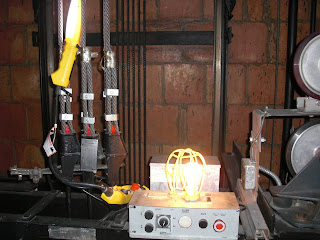
That was a fascinating history lesson, no? Well, now it's time to jump on board car 27. And by on board, I mean, get on that shit! So, the two round things are the door operators. The I-beam with the 27 on it is the cross beam, and the black things anchoring the cables to the beam are called shackles.

You can only see a glimpse of the terror I truly felt. I could be getting leg gnawed off by wild animals, and if I saw a camera, I'd still smile. It's kind of a character defect.

Inside that gray box is the load weight device. That device tells the controller how much weight is in the car, and when it reaches a certain capacity, it won't stop for pick-up calls. That's why you'll stand waiting for an elevator forever at five o'clock. Jam-packed elevators are smarter than we are, and won't allow cramming.

The gray box with the buttons on it is the Inspection Station, which allows the mechanic to move the car while on top of it.
That top wheel is the tachometer, which counts revolutions and tells the controller exactly where the car is located. There is a corresponding tach in the motor, and the two tachs must be in synch. The bottom wheel is a roller guide, which rolls on the rails.

This is the bottom of car 28.

The side of car 28. You're seeing an old escape door--that's how you'd get rescued from a broken elevator back in the day.

Getting Shafted

Here comes the counterweight. I now know why it's called the silent killer. It scared the shit out of me. I felt like Marie Antoinette. It whooshed by me at a high rate of speed and left me with goosebumps all over my body. It was like having a shark swim silently by you, and take no notice. Brr.

There it goes...

After about ten minutes on the car, I begged for mercy. I cried 'uncle'. I waved the white flag. I emerged from the top of the car, knees a little trembly, and that concluded our tour. There was really nothing left to show me in the world of elevators. I hope you feel as educated as I do about the inner workings of a miraculous machine I usually take for granted. If you happen to take notice of an elevator mechanic doing his thing, give him or her propers for doing us all a solid--keeping us safe in the world of vertical transport.
Clearly, elevator technology has evolved according to the digital age's needs. The fancy new stuff is referred to as "solid state" but this old Otis "relay logic" elevator is a neat-o analog version of the machines we saw earlier. While the equipment is still functional, the elevator car is now used as a closet. According to our EM, most of the building's inhabitants don't even know that the closet is a working elevator.
This is the generator, which features many of the same components as the motors upstairs, like the copper armature and carbon brushes. The power coming into the building is AC, but the motors were DC, so the generators took that power and converted it to DC.

This is the controller. Much different than the controllers in the machine room that we saw, eh? There's a certain beauty to it, I think.

These are the old school "cards", which were hand controlled. When this system was used, you couldn't call an elevator by pressing a button in the hall. The operator had to flip the switches on this card rack.

Here's the motor:

And this is a gear. Relay logic was geared, but this building's solid state is gearless. This is like a freaking dinosaur:

The sheave:

This is a resister. It's an old transformer, which basically "steps down" power.

This is a rectifier, which also converts AC to DC:

Instead of an oil buffer, this counterweight has a spring. If a rise is over 200 feet, it requires an oil buffer, which explains why this whole get-up is outdated. That spring doesn't make me feel safe.

The counterweight:

That was a fascinating history lesson, no? Well, now it's time to jump on board car 27. And by on board, I mean, get on that shit! So, the two round things are the door operators. The I-beam with the 27 on it is the cross beam, and the black things anchoring the cables to the beam are called shackles.

You can only see a glimpse of the terror I truly felt. I could be getting leg gnawed off by wild animals, and if I saw a camera, I'd still smile. It's kind of a character defect.

Inside that gray box is the load weight device. That device tells the controller how much weight is in the car, and when it reaches a certain capacity, it won't stop for pick-up calls. That's why you'll stand waiting for an elevator forever at five o'clock. Jam-packed elevators are smarter than we are, and won't allow cramming.

The gray box with the buttons on it is the Inspection Station, which allows the mechanic to move the car while on top of it.

That top wheel is the tachometer, which counts revolutions and tells the controller exactly where the car is located. There is a corresponding tach in the motor, and the two tachs must be in synch. The bottom wheel is a roller guide, which rolls on the rails.

This is the bottom of car 28.

The side of car 28. You're seeing an old escape door--that's how you'd get rescued from a broken elevator back in the day.

Getting Shafted

Here comes the counterweight. I now know why it's called the silent killer. It scared the shit out of me. I felt like Marie Antoinette. It whooshed by me at a high rate of speed and left me with goosebumps all over my body. It was like having a shark swim silently by you, and take no notice. Brr.

There it goes...

After about ten minutes on the car, I begged for mercy. I cried 'uncle'. I waved the white flag. I emerged from the top of the car, knees a little trembly, and that concluded our tour. There was really nothing left to show me in the world of elevators. I hope you feel as educated as I do about the inner workings of a miraculous machine I usually take for granted. If you happen to take notice of an elevator mechanic doing his thing, give him or her propers for doing us all a solid--keeping us safe in the world of vertical transport.
Nora Gets Shafted--Part Three
The first Take Nora To Work Day was a fascinating adventure in exploring the world of elevator mechanics. Review Parts One, Two and Two if you're just now joining us. Walk with me now into The Pit...

This is looking up a shaft.

This contrapiton is the buffer. If the elevator were to crash down the shaft, it would hit the pipe, which is a piston. The pipe is filled with oil, just like a car's shock absorber. Amazingly enough, the buffer is enough to keep it from crashing to the pit floor.

This is the tail sheave. It's connected to the car and the flyball governor by a rope, which communicates the car's speed.

On the left of the shaft is counterweight, also known as The Silent Killer (dun dun duuuuuuun!):

Here we have the compensating, or comp sheave, which, predictably, compensates for the weight of the car, and helps pull it.

These are the comp ropes. They go from the bottom of the car to the bottom of the counterweight. Meanwhile, the cables from the motors in the machine room go from the top of the car, around the machine to the top of the counterweight.

This very low-tech piece of equipment is called a timber, because it's, well, a big hunk of timber. If cables need to be changed, the counterweight is rested upon the timber. The car would then be level with the top floor,and the mechanic can safely change the cables.

This is a view of the bottom of a car. Those rubber cables connect the car to the controllers in the machine room.

It's not all preventative maintenance, fiddling with circuit boards and working in the pit, though, kids. Elevator mechanics have access to all kinds of interesting areas of the building. Let's see what the bowels of this particular Chicago skyscraper look like ...
Walking through the boiler room in the sub basement:

Entering the hydraulic elevator, which will bring us to the sub-sub-basement. The EM had to operate it manually.

He takes me to the nicest places. Right after I snapped this photo, he kicked away a mouse-sized roach. I think I might just have a crush on this particular elevator mechanic.

Look at the floor: coal cart rails from back in the olden days. There was an enormous amount of kickass door frames, cabinets and other furniture. Apparently, they don't make them like that anymore, so the building just holds onto them for parts and such.

A coal storage bin, where it would dump out into the carts into the room below:

We emerged from the sub-sub-basement for two more adventures. Sifting through decades of history and kicking aside huge cockroaches is only part of the fun. Come back to read about some old Otis relay logic technology and my death-defying trip on top of car 27.

This is looking up a shaft.

This contrapiton is the buffer. If the elevator were to crash down the shaft, it would hit the pipe, which is a piston. The pipe is filled with oil, just like a car's shock absorber. Amazingly enough, the buffer is enough to keep it from crashing to the pit floor.

This is the tail sheave. It's connected to the car and the flyball governor by a rope, which communicates the car's speed.

On the left of the shaft is counterweight, also known as The Silent Killer (dun dun duuuuuuun!):

Here we have the compensating, or comp sheave, which, predictably, compensates for the weight of the car, and helps pull it.

These are the comp ropes. They go from the bottom of the car to the bottom of the counterweight. Meanwhile, the cables from the motors in the machine room go from the top of the car, around the machine to the top of the counterweight.

This very low-tech piece of equipment is called a timber, because it's, well, a big hunk of timber. If cables need to be changed, the counterweight is rested upon the timber. The car would then be level with the top floor,and the mechanic can safely change the cables.

This is a view of the bottom of a car. Those rubber cables connect the car to the controllers in the machine room.

It's not all preventative maintenance, fiddling with circuit boards and working in the pit, though, kids. Elevator mechanics have access to all kinds of interesting areas of the building. Let's see what the bowels of this particular Chicago skyscraper look like ...
Walking through the boiler room in the sub basement:

Entering the hydraulic elevator, which will bring us to the sub-sub-basement. The EM had to operate it manually.

He takes me to the nicest places. Right after I snapped this photo, he kicked away a mouse-sized roach. I think I might just have a crush on this particular elevator mechanic.

Look at the floor: coal cart rails from back in the olden days. There was an enormous amount of kickass door frames, cabinets and other furniture. Apparently, they don't make them like that anymore, so the building just holds onto them for parts and such.

A coal storage bin, where it would dump out into the carts into the room below:

We emerged from the sub-sub-basement for two more adventures. Sifting through decades of history and kicking aside huge cockroaches is only part of the fun. Come back to read about some old Otis relay logic technology and my death-defying trip on top of car 27.
Nora Gets Shafted--Part Two
We're back for the second installment. If you haven't read Part One, catch up, will ya? To review, our friendly Elevator Mechanic (EM) goes into the office, checks the computer to see if there are any pressing elevator issues to attend to, might use that service tool to run some diagnostic tests. And if nothing is cooking on that front, he probably just gets started on preventative maintenance.
Here's a picture of some of the motors. They're original Otis motors installed circa 1938 (note--just because it's Otis machinery doesn't mean my EM is an Otis employee):

This picture gives you an idea of how big they are:

Six cables are double wound around the sheave (pronounced "shiv"). One cable is strong enough to bear the weight of a car, but six cables are used for traction. My EM compared it to a dually truck--more tires equal better traction. To the right are the armature windings and on top are field coils. The coils are polarized. They energize and pull the armature in which ever direction it needs to go. Going up? Or down?

That's a brake plunger. There's one on the back side, too. When the motor stops, the core demagnetizes and pulls the metal plungers in. The spring puts pressure on the brakes, thus holding the elevator in place. The elevator never stops on these brakes, they just hold the car in place.
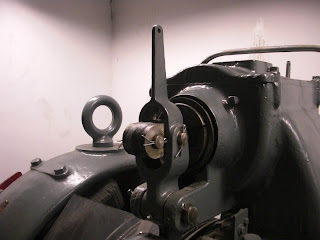
The red wheel holds the copper armature. Carbon brushes create voltage on the rotating copper which controls the car's leveling speed. As in, it tells the car to slow down as it approaches a floor.

The abrasive stoning brush is used to keep the copper armature clean. It's used like so whenever necessary, typically about ten minutes twice a year. That's an example of preventative maintenance.

This is where the bearing is housed. Gotta put oil up in that bitch:

That's the oil level. There's a chain that wraps around inside that carries oil around the shaft. Yes, the shaft must be well-lubed...

These are flyball governors, which, well, govern the speed of the cars. Using centrifugal force, or the principal of proportional control ... uh ...here's what Wikipedia says about flyball governors. But from what I gathered, when the wheels spin, the flyballs go higher, and if they go high enough, they trip an electric switch for the brake. If that doesn't work, the manual brake goes off, sets the safeties in the car and the mechanic has to manually reset the brakes. That rarely, if ever, happens.

But if it does happen, this is the key used to manually reset the brake. It's about two feet long.

The EM told me to make myself useful:

That's it for the machine room. Now we're off to peek around to see what's what from the roof. But first, this is the southbound view from the 45th floor. That's the Board of Trade building. The windows are covered in colored plastic sheets so it looks cool lit up at night. It makes for a strange inner atmosphere, though:

We pulled off the plastic sheet so I could get a close up of the goddess, Ceres. I know--it's not elevator-y. But it's very cool, and this is my adventure, so roll with it.

Going up on the roof wasn't very elevator-y, either. I had to take off my shoes to climb the metal ladder, which hurt my bare feet, but that's what I get for wearing cute shoes to this tour. Anyway, it was worth it to get these pictures.
Facing north:

Facing east:

Facing south:

Facing west:

After the exciting trip to the top of the building, we hopped in the freight elevator to go down to the sub-sub-basement. Stay tuned for the next installment of Nora Gets Shafted!
Here's a picture of some of the motors. They're original Otis motors installed circa 1938 (note--just because it's Otis machinery doesn't mean my EM is an Otis employee):

This picture gives you an idea of how big they are:

Six cables are double wound around the sheave (pronounced "shiv"). One cable is strong enough to bear the weight of a car, but six cables are used for traction. My EM compared it to a dually truck--more tires equal better traction. To the right are the armature windings and on top are field coils. The coils are polarized. They energize and pull the armature in which ever direction it needs to go. Going up? Or down?

That's a brake plunger. There's one on the back side, too. When the motor stops, the core demagnetizes and pulls the metal plungers in. The spring puts pressure on the brakes, thus holding the elevator in place. The elevator never stops on these brakes, they just hold the car in place.

The red wheel holds the copper armature. Carbon brushes create voltage on the rotating copper which controls the car's leveling speed. As in, it tells the car to slow down as it approaches a floor.

The abrasive stoning brush is used to keep the copper armature clean. It's used like so whenever necessary, typically about ten minutes twice a year. That's an example of preventative maintenance.

This is where the bearing is housed. Gotta put oil up in that bitch:

That's the oil level. There's a chain that wraps around inside that carries oil around the shaft. Yes, the shaft must be well-lubed...

These are flyball governors, which, well, govern the speed of the cars. Using centrifugal force, or the principal of proportional control ... uh ...here's what Wikipedia says about flyball governors. But from what I gathered, when the wheels spin, the flyballs go higher, and if they go high enough, they trip an electric switch for the brake. If that doesn't work, the manual brake goes off, sets the safeties in the car and the mechanic has to manually reset the brakes. That rarely, if ever, happens.

But if it does happen, this is the key used to manually reset the brake. It's about two feet long.

The EM told me to make myself useful:

That's it for the machine room. Now we're off to peek around to see what's what from the roof. But first, this is the southbound view from the 45th floor. That's the Board of Trade building. The windows are covered in colored plastic sheets so it looks cool lit up at night. It makes for a strange inner atmosphere, though:

We pulled off the plastic sheet so I could get a close up of the goddess, Ceres. I know--it's not elevator-y. But it's very cool, and this is my adventure, so roll with it.

Going up on the roof wasn't very elevator-y, either. I had to take off my shoes to climb the metal ladder, which hurt my bare feet, but that's what I get for wearing cute shoes to this tour. Anyway, it was worth it to get these pictures.
Facing north:

Facing east:

Facing south:

Facing west:

After the exciting trip to the top of the building, we hopped in the freight elevator to go down to the sub-sub-basement. Stay tuned for the next installment of Nora Gets Shafted!
Subscribe to:
Posts (Atom)


